As intended, I was up a little earlier than normal today. I planned to drive at least 3 hours before returning to home base, and another 3 hours or more back again, plus whatever detours I happened across along the way. It was therefore going to be a lot of time behind the wheel as I explored the gems on offer along the rugged Pembrokeshire coastline.
John was happily tinkering with his new air fryer that arrived last night. He was like a kid in a candy store, marvelling over his new toy. The first thing he tried out? Boiled eggs. I wouldn’t have considered using an air fryer to boil eggs, and we have two of them. As it happened, it worked quite well. I may give that a try when I get back home.
After shovelling down a couple of slices of toast and butter, I whipped up a ham sandwich with some loose-leaf lettuce for later this afternoon. I programmed Cardigan into my satnav and set off in a south-westerly direction, bidding John farewell. The weather was looking very good. Indeed, it remained excellent for the entire day.
Although I was heading towards Cardigan, my first stop of the day was to be New Quay, not to be confused with another Welsh town called Newquay. That was a last-minute decision I made when I reached that turnoff. New Quay promised some good photo opportunities. I had originally considered stopping there on my way back, but as the weather was cooperating, I figured I’d strike while the iron was hot. The town itself is indeed quite picturesque, and the secluded beachy bay beckoned. Alas, despite my best efforts, I just couldn’t find a place to park the car. The one car park was already full, and the narrow streets were never going to provide any decent nearby options. Eventually, I had to give up on New Quay altogether, at least for now. I turned around and made my way back out to the A487 to continue my south-westerly route.
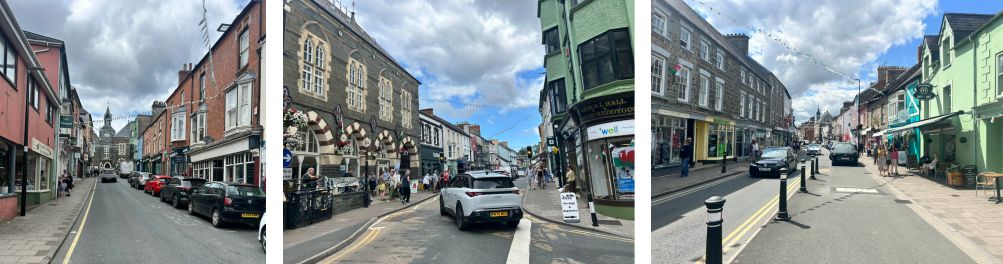
Driving through Wales inevitably involves passing through quaint little towns, where it’s often necessary to share the roads that are barely wide enough for a single car. This means having to stop and give way, or proceeding when an oncoming driver feels it’s best that they give way to you. There’s an unwritten social contract between drivers here. You read the situation and decide when you should yield or not. In fact, you automatically become accustomed to looking for opportunities to yield. The idea is that it’s often better for the greater good to delay yourself occasionally. It’s an inherently unselfish behaviour you end up adopting. This aligns with the British nature of being inherently polite and courteous. By and large, drivers here are indeed courteous. It’s customary to wave to say thank you whenever you want to acknowledge when someone waited for you to pass—especially when they could have just ploughed ahead. If everyone was out for themselves, it would often result in a gridlock, and things just wouldn’t work as well.
Just outside of Cardigan, I found a petrol station and topped up. That increased my range to around 800 km (my car’s dashboard is configured for metric units—I cannot change it). By the time this trip is over and done with, I will probably have added around three thousand kilometres to the car’s odometer. I can’t see how it would have been practical to make that journey with the electric car. I haven’t seen many charging opportunities here in Wales.
I loved Cardigan—straight out of a picture postcard. There are a handful of narrow high streets lined with quaint shops, eateries, art galleries, as well as all the usual modern retail chains. A centuries-old church around the corner provides a point of reference—its steeple is one of the first things you see. The classic three-storey buildings look to date from the Georgian to early Victorian era, during the town’s prosperous years as a port and market town. The street pattern itself is from medieval times. Like the building facades in many other Welsh towns, those here in Cardigan are painted with a patchwork of pastel colours, giving the town centre a distinct style. It was a busy summer’s day on the high street. The whole place buzzed.
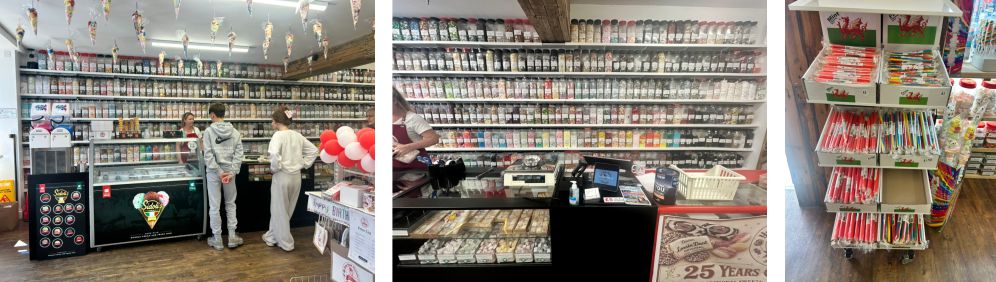
One of the shops I wandered into was a sweet shop. The inside walls were lined with rows of dozens of glass bottles, each filled with different boiled sweets, chocolates, chews, liquorice, etc. Displaying sweets like this was common when I was a child, but you see it much less so nowadays. Seeing it instantly took me back to when I was a child, spending a few pennies of my pocket money on something delicious from the newsagent that doubled up as a sweet shop. They were also selling rocks—another traditional British confectionery typically found in seaside towns. A rock was a twelve-inch-long cylinder of boiled sweet—as hard as a rock—usually about a centimetre or so thick. It’s made so that a pattern—typically a face or some writing—can be seen through its entire cross-section. If the sugary ingredient doesn’t rot your teeth, trying to bite into one might crack them. Although a popular favourite with children, they are incredibly bad for you. It’s a wonder they are still sold. I was surprised to see them on sale here.
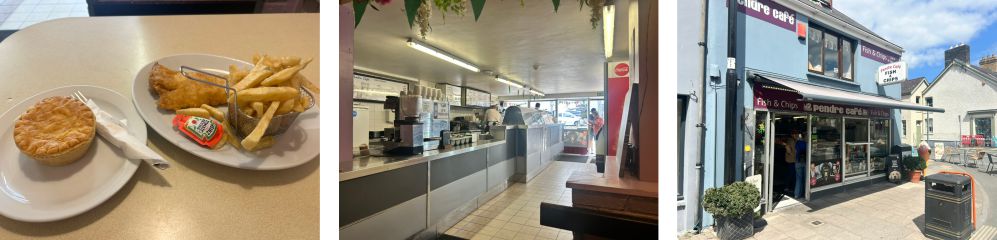
I parked the car next to the church and wandered the streets a little, taking it all in. I buckled under the allure of another opportunity to enjoy my childhood favourite of fish ‘n’ chips again. Several chip shops beckoned, so I chose one that looked especially inviting and went in for a sit-down lunch. Yes, I had packed sandwiches, and yes, it was an indulgence, but I find the scent of salt and vinegar on battered fish just so enticing—I simply couldn’t resist. It was oh so delicious. My sandwiches wouldn’t go to waste. They will be my dinner later. Since a picture tells a thousand words, I snapped a good number of scene-setting photos for my blog, and made my way back to the car. I didn’t have far to drive.
My next destination was Poppit Sands Beach, just a couple of kilometres farther. What I found there was probably one of the best secluded sandy beaches you’ll find anywhere along the UK’s coast. The white sand was soft under my feet, the water warm and inviting, and the sea breeze just about perfect. The entire crescent-shaped gem was punctuated by a rocky coastline of cliffs at either end of the kilometre-long beach. There were plenty of families enjoying the beach, but it didn’t feel crowded at all. I was instantly whisked back in time to when I was a child, and we visited places like Camber Sands or Jaywick.
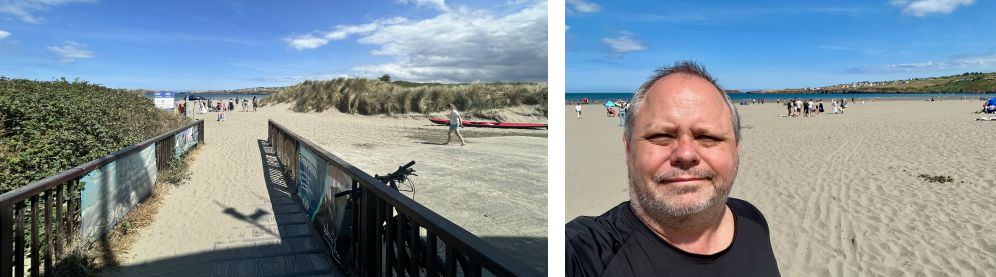
After a casual stroll through the warm waters, I found a spot and lay myself down under the sun for half an hour. It was bliss. The sun was warm, but not excessively hot. I whipped off my top to fashion a makeshift pillow, closing my eyes and taking in all the scents and sounds around me. Before long, the sun grew a little too intense, so I pulled my top back off the sand and draped it over my face instead, closing my eyes and taking in all the scents and sounds around me. A couple of nearby kids were chatting about sandcastles and catching small crabs. In the distance, a pair of older kids were throwing a ball back and forth. I could hear the indistinct chatter from the two lifeguards keeping an eagle eye on everyone. A father spoke to his wife in English, and then to his kids in Welsh. I love the sound of Welsh. Some of the sounds are quite similar to Dutch. In fact, I mistook a Dutch family for a Welsh family the other day in Aberystwyth because the sounds were so similar. I had to chuckle to myself when that penny dropped.
Lying on the sand, the sun was starting to warm me up, so I draped my top over my head. I concentrated on my breathing. All the while, the wind and light splashing of waves and children’s laughter echoed around me. I tried to relax my body as much as possible—just to be in the moment. Each time my conscious thoughts drifted off somewhere, my right-hand tremor kept bringing me back to reality. It’s a curious thing. If I concentrate, I can dampen the tremors, but the moment my concentration drifts elsewhere, the tremors worsen. It’s like a self-reinforcing feedback loop. It’s annoying—distracting. I cannot escape from it. I tried digging my hand into the sand to wedge it into a fixed position. It wasn’t helping. I did what I could to ignore it. After half an hour, the distraction overwhelmed my urge to remain put. I got up, picked up my sandals, sock and phone, and meandered lethargically back to the car.
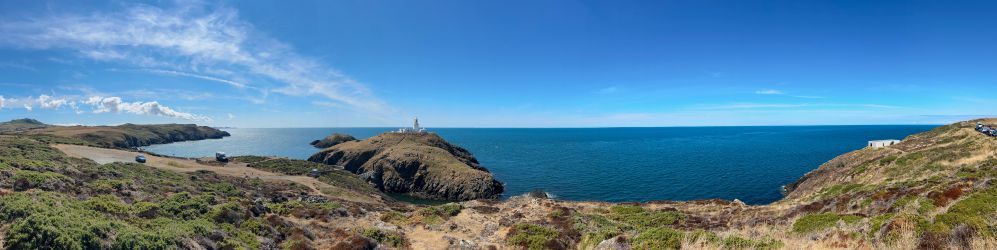
I loved my little interlude at Poppit Sands Beach, but there were yet more places to explore awaiting me today. The next was Strumble Head, not far beyond Fishguard, another hour down the coast. Sandy and I have actually been to Fishguard before. It’s the launching point for the ferry to Rosslare in Ireland. We took that ferry when we were campervanning around the UK back in 2003. Strumble Head is one of the scenic spots that Claude had recommended. I’m glad it did. The windswept cliffs that rise up from the crashing waves are indeed a sight to behold. Perched atop a rocky outcrop island, joined to the mainland by a non-publicly accessible footbridge, is a whitewashed lighthouse—fully functional with a bright rotating light in operation. I couldn’t see the Irish coast, but I did spot a ferry making the crossing at one point.
There’s a 45-minute hiking circuit that starts and finishes at the lighthouse island. I was already struggling physically. I walked down to the level of the footbridge to get a better picture of the crystal clear waters, and already found it a real chore to walk back up to the car park. It was clear I was never going to survive the longer hike, which would have involved many such ups and downs. I would have to live with the photos I was able to take from within walking distance of the car. That turned out to be more than enough.
Despite being a good 3-hour drive from Llanwnog, Strumble Head was well worth the trip. There was just one more must-see spot that Claude had recommended—Ceibwr Bay. It was just outside Cardigan. I probably could have taken that in when I was there earlier today, but I forgot it was on my list. Since I had to pass by Cardigan to get back home anyway, I made my way there. Again, I wasn’t disappointed. It was another opportunity to put my phone’s camera into overdrive. The cliffs and rocks were no less spectacular than Strumble Head. I’ve travelled to many coastlines around the world, and Pembrokeshire has turned out to really hold its own against all of them.
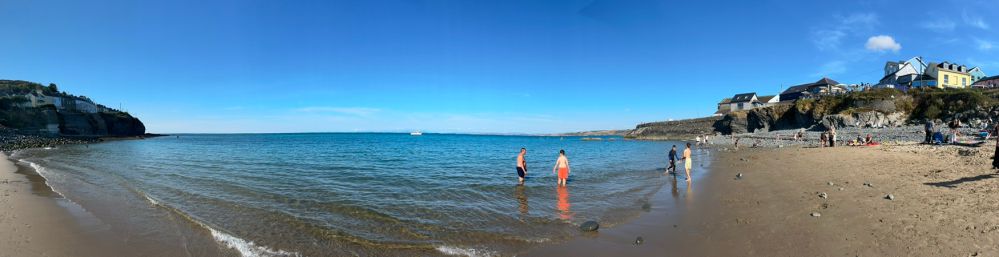
It was by now around 4 pm. The one remaining thing I wanted to squeeze in was New Quay. There were photo opportunities there, and I didn’t want to get so tantalisingly close and miss them. As luck would have it, I did manage to find a vacant spot in the New Quay car park. It’s a small town, with an even smaller beach cove, but it sits nestled beneath another quaint, bustling little seaside town. I duly snapped my fill, and even managed to make my way down to the little beach. The sand wasn’t as soft and fluffy as Poppit Sands, but there were hundreds of round and very smooth boulders on either side of the cove. It was an inviting place. I would have lingered longer and explored all the nooks and crannies, but the shadows were starting to lengthen. I rolled up my trousers to test the waters for a few minutes before making my way back up to the car.
It was an uneventful final ninety-minute drive back to Llanwnog from New Quay. Once home, I tidied up my haul of photos and set to work writing up this blog—first in the garden soaking up the remaining summer sunshine, but later inside.
Today was all about what Wales had to offer by way of culture and sights. Wales didn’t disappoint. My little excursion today was an indulgence that may not come around again. I’m glad I took advantage of it while I could. I still have several more days here, and I am planning on visiting Shrewsbury—a much larger town— this weekend. If I left today, I’d do so satisfied I had seen some of the best of what Wales has to offer. There may yet be a few gems to uncover.