Last night I had an epiphany. I could visit Cardiff today. I’ve never been there, and it’s no farther away than my jaunt down the Pembrokeshire coastline the other day, so I figured it would be as good a plan as any. I had no therapy sessions scheduled for today, so there was nothing constraining me.
With Claude’s help, I cobbled some ideas together for what to see along the way. As luck would have it, a near-direct route to Cardiff from here takes in a range of worthy sightseeing opportunities, including the Brecon Beacons. I’ve heard of this extraordinary geological feature, but knew little of it, other than it’s a sight of outstanding natural beauty. Finally, the opportunity presented itself for me to find out for myself what all the fuss is about.
I was first up this morning, and the weather was shaping up for yet more perfect conditions for a lazy countryside road trip. There were barely a few wisps of cloud in an otherwise gloriously blue sky, and the mercury was already starting to rise. John was up just in time to see me off. I downed my daily meds (mostly vitamins and allergy tablets), polished off some toast and butter, and hopped into the car. Claude’s first recommendation for me was the Elan Valley dams, just a short detour from my main route near Rhayader.
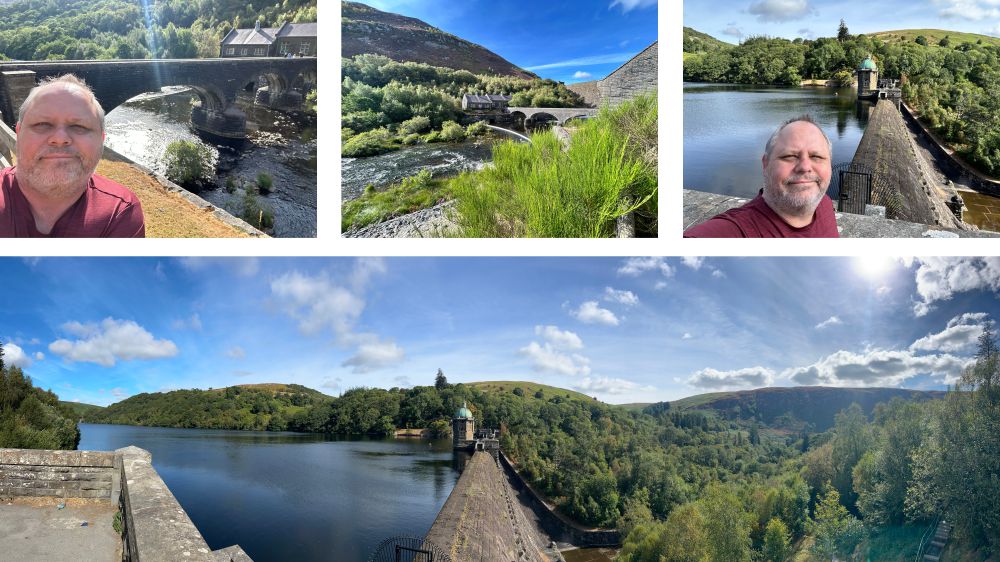
The first stop was the Caban Coch dam. This is a compensation reservoir. When the Elan Valley dams were first commissioned, it was mandated that towns and businesses downstream weren’t deprived of their water source, so this dam releases a constant flow of water into the River Elan and subsequently the Wye.

There’s a nice visitor centre, but I was more interested in the dam itself. I had come here today for photo opportunities. Much to my chagrin, the visitor centre is near the base of the dam. The slow-trickling stream emanating from the bottom is picturesque enough, but the real photographic action would be at the top, where I expected some terrific views. Unfortunately for me, the only way I could see to get up there was along an irregular trail up the embankment on one side. It had some makeshift steps in places, but it was really quite steep, and my legs were begging for relief before I even reached the halfway point. I was seriously huffing and puffing by the time I reached the top. At one point, I worried I might have a coronary. I get that I’m not in the best of physical condition, but I’m also starting to wonder more and more whether my struggling to walk any meaningful distance might be attributed to the Parkinson’s in some way.
The views at the top were indeed worth it…just. The climb really took a lot out of me, and I had to sit down for several minutes while up there. After snapping the requisite shots, I made my way back down again, along with another family, some of whom were also wondering, like I was, whether the climb was worth the pain involved. It took me longer than it should have to get back down again, on account of me barely able to shuffle one step at a time.
Back to the relative comfort of my car, I pulled out of the car park and set course for the next dam in this system, which was just a few kilometres farther. I got no farther than about three hundred metres before I spotted a perfect parking layby right on the other side of the dam at the top. Oh, the air was blue! I mumbled to myself: God dam it, all that fekking effort and the f*ck#@ stupid c*## wan$%# #$$#@$ #$$ $$#@! And that’s all I have to say on the matter!
The roads all around these parts are very narrow and very winding. Oftentimes, I could scarcely get out of second gear. The next viewing point was, fortunately, at the side of the top of the dam itself, so there was no need to climb up or down any gradients.
The second dam I encountered was Garreg Ddu, but there was little to see as I drove across it. The final dam of the drive was Pen y Garreg, which was rather more interesting to look at. A standout feature was a domed two-storey-high stone tower housing a water valve that sits perched in the centre of the dam at the very top. The views on either side of the dams were, of course, lovely, and I took plenty of photos from as many angles as I could.
One thing that stood out to me today was just how many sheep there are all over the place. Near where John and Lisa live, they are typically enclosed in the various fields the farmer shuffles them between. Out here, they are all over the roads as well. I found myself having to suddenly brake on numerous occasions just to avoid the possibility one might stray into the road. Indeed, I had to come to a full stop on several occasions because the ditsy animals were casually meandering right in the centre of the bloody road itself.
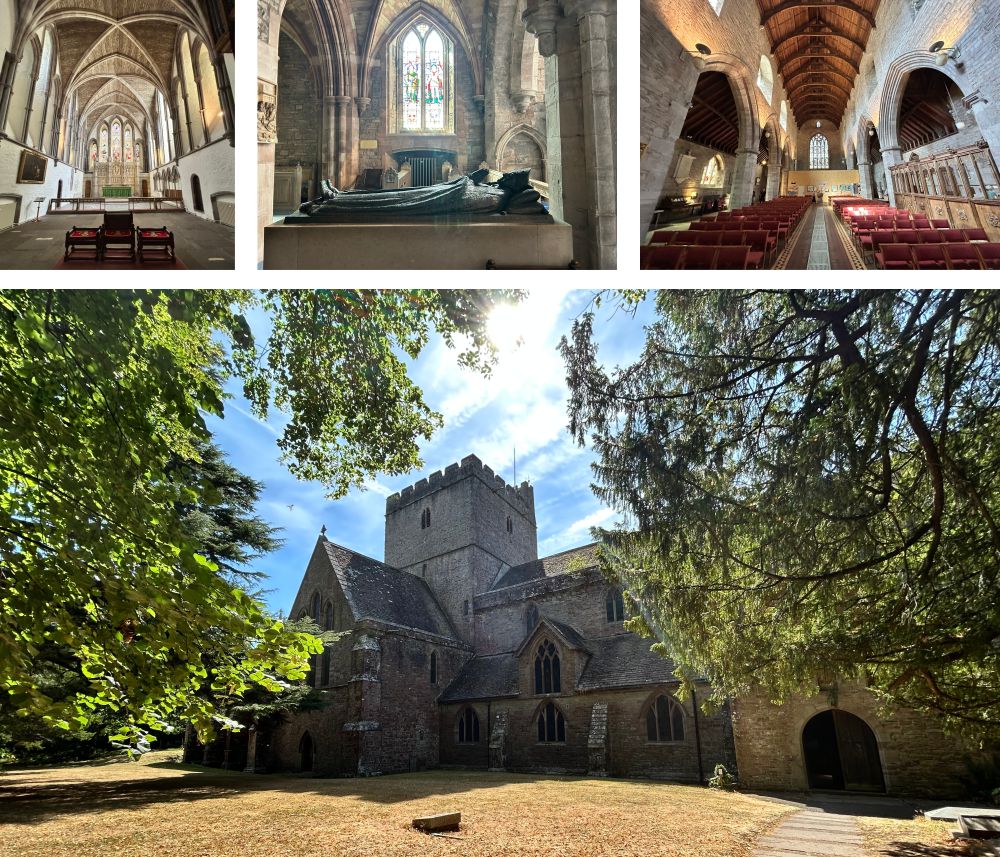
Having seen the glorious dams of the Elan Valley, the next stop about half an hour farther was the little town of Brecon. I could easily have spent more time in Brecon itself, but in the end I restricted myself to just a brief visit to Brecon Cathedral, one of the town’s true gems. We really know how to do history well here in the UK. Brecon Cathedral is over nine hundred years old. What’s there today is grand enough, but most of the original structure is lost to time. As is so often the case with ancient structures around the UK, parts of it are add-ons or reconstructions atop earlier buildings from centuries ago.
The inside of the cathedral, like many similar religious buildings, is really quite awe-inspiring. Tall, wonderfully colourful stained glass windows flood the central nave, aisles, and chancel. The arches holding up the ceiling channel the roof’s weight down to impressive stone pillars. Just looking up at the architecture is enough to fill anyone with spiritual thoughts and feelings.
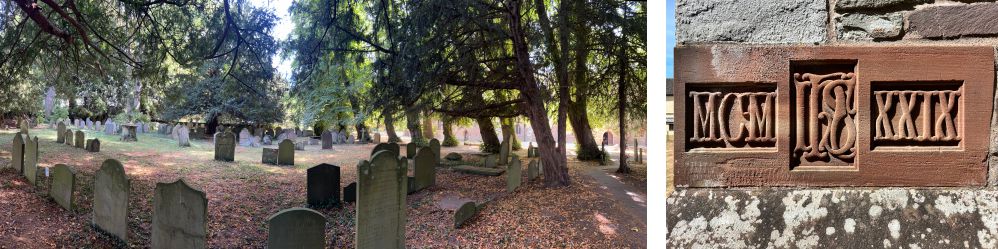
The grounds around the cathedral were also worth the effort. The adjacent cemetery was nestled beneath a cluster of trees. Despite it being midday, there was enough shade in that glade to invoke an eerie sense of sombreness among all the tombstones, none of which was fully upright or straight.
As I walked around the cathedral’s perimeter, I stumbled upon a curious stone embedded into one of the outside corners. It was red sandstone, in contrast to the slate grey stonework of the rest of the building, and about 30 centimetres tall by about a meter wide. Carved into this stone was a Roman numerals date (1929) and what looked like an ornate monogram. It was either INS or IHS. The letters wove around each other, which wasn’t helping me decipher it. On the perpendicular side was what I originally thought might be a portcullis, but upon further inspection it turned out to be a depiction of a gridiron. In church iconography, that’s a reference to St Lawrence, a 3rd-century Roman deacon. Legend has it he was martyred by being roasted on a gridiron. If legend is to be believed, he evidently quipped during his deathly ordeal, “Turn me over, I’m done on this side.” The IHS monogram may be a reference to the first three letters of Jesus’s name in Greek (ΙΗΣ, iota-eta-sigma), later popularly interpreted as Iesus Hominum Salvator — “Jesus, Saviour of Mankind.” The date of 1929 likely references the building’s restoration date.
I did have an interesting discussion with a couple of the church staff about the date stone, as it had piqued my interest and I wanted to verify the facts for my blog. They weren’t entirely certain about the details, but there was an older gentleman there whom they thought would have more answers. He turned out to be nearly completely deaf. My whole interaction with him played out like a Monty Python comedy of errors, with me having to repeat things often 3-4 times, progressively louder each time. I thought he wanted me to show him the stone so he could tell me about it, so I led him around the building to show it. When we got there, he proclaimed, “Ah, there it is. I’ll leave you to it, then,” and then walked off. That left me a little baffled, so I just waited until he was out of sight and made my way back to the car. Some you win, and some you lose.
Brecon is on the edge of the Brecon Beacons national park, a geological landmark—featuring a series of ridges and valleys—encompassing nearly 1,350 km2. It’s a stunningly beautiful place with barren hills devoid of trees, undulating across the landscape stretching as far as the eye can see. You can see the sheep as little specs of white littering the hillsides.
English and Welsh differ on the etymology of the name Brecon Beacons. Brecon is derived from a 5th-century king called Brychan whose realm became known as Brycheiniog — “the land of Brychan.” The Normans anglicised that to Brecknock, and the county town became Brecon. So when the park readopted the Welsh name Bannau Brycheiniog in 2023, it was restoring the older form: “the peaks of Brychan’s kingdom.” The Beacons part of the name likely comes from the early use of the hilltops to light fires as beacons—a rudimentary form of communication across great distances.
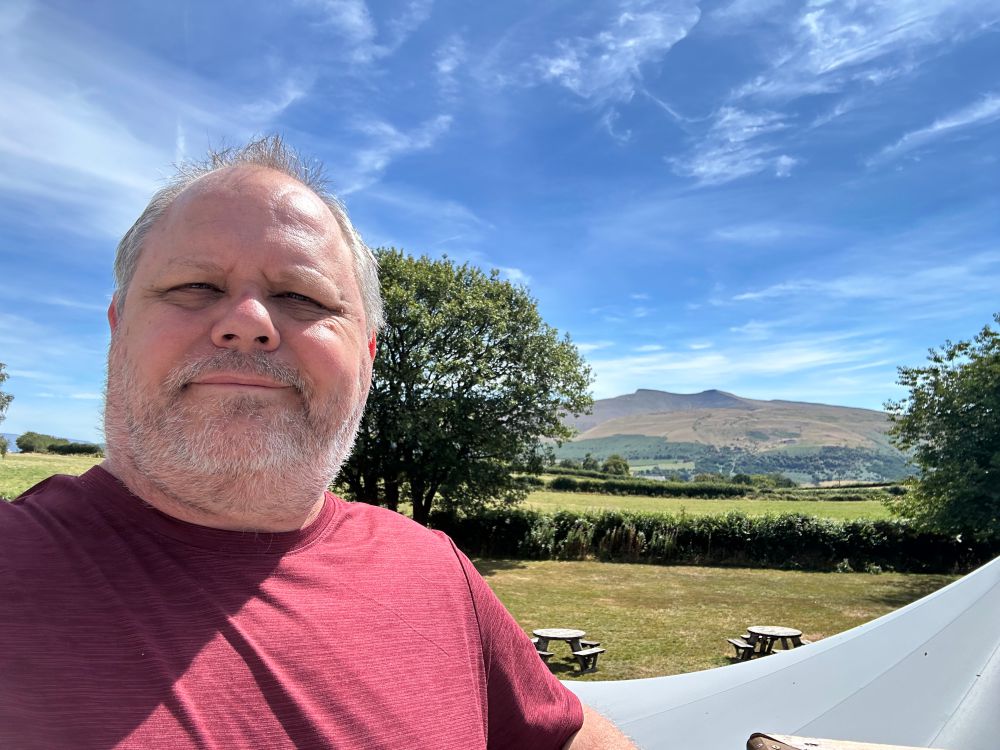
On the edge of the national park is the Bannau Brycheiniog Visitor Centre. It’s a nice enough visitor centre as these things go, though I tend to find they mainly cater to tourists with overpriced trinkets, handicrafts, perhaps a restaurant, and some local literature. What the location has going for it is some great views of some of the Brecon Beacons summits in the distance.
I stayed at the visitor centre long enough to admire the view, but since I was never going to tolerate a multi-kilometre hiking trail, there was little else to hold my attention, so I got back into the car and continued to enjoy some wonderful scenery driving through the national park.
Wedged between a couple of summits, as the road weaved up and down around the hillsides, were a couple of parking laybys conveniently located for people to stop and enjoy the views, which I did. One such location was the Storey Arms Pass. It’s not much more than a layby, but I did notice there was a hotel just up the road. Several of the hiking trails leading away from the layby were dotted with hikers. From the looks of it, the elevation they would have had to scale was considerable and best left to the fit and agile. I took one look and jumped right back into my car.
I lost count of the weird and wonderful names of the villages I passed through. Some of them really roll off the tongue, like Llanwrthwl and Lôn yr Afon. For my non-British readers overseas, no, I can’t pronounce any of them either. Each time I try, I end up with phlegm all over my steering wheel.
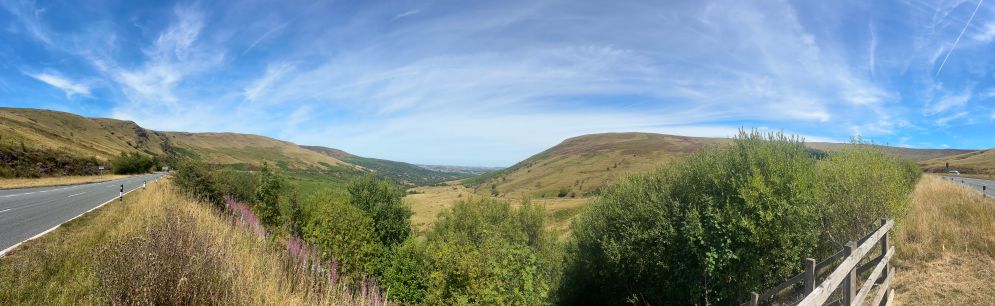
Passing through the Brecon Beacons national park, completed the scenic portion of my day trip. My next destination would be the Welsh capital itself—Cardiff—which I reached after another 45 minutes behind the wheel.
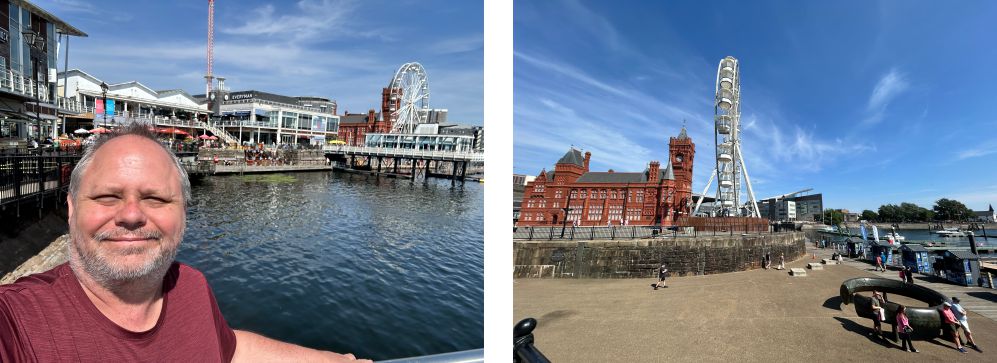
Cardiff is a compact city and pleasant enough. There’s a bustling harbour with a plethora of restaurants and a collection of amusement rides. One of these was a carnival Ferris wheel. I had to chuckle when I overheard a nearby mother with her children. One of them asked, “Is that the London Eye?” Seriously, they’re walking among us!
With the smell of food emanating from the various restaurants, I buckled and sat down at Nando’s for a peri-peri treat. It’s hardly Welsh cuisine, but sitting down for half an hour did wonders for my aching feet
The Wales Millennium Centre is a prominent arts venue in town, with a distinctive façade featuring enormous letters spelling out the words: “Creu gwir fel gwydr o ffwrnais awen”, and a companion English verse: “In these stones horizons sing”. Those words were written for the building by Gwyneth Lewis, who was then National Poet of Wales. The building is just as impressive inside as it is outside, but with nothing significant happening in the building today, there wasn’t much impetus to hang around. To be honest, there really wasn’t much else to keep me interested in Cardiff itself, either. My two-hour parking time was fast approaching, so I trundled through the heat back to the sanctity of my car.
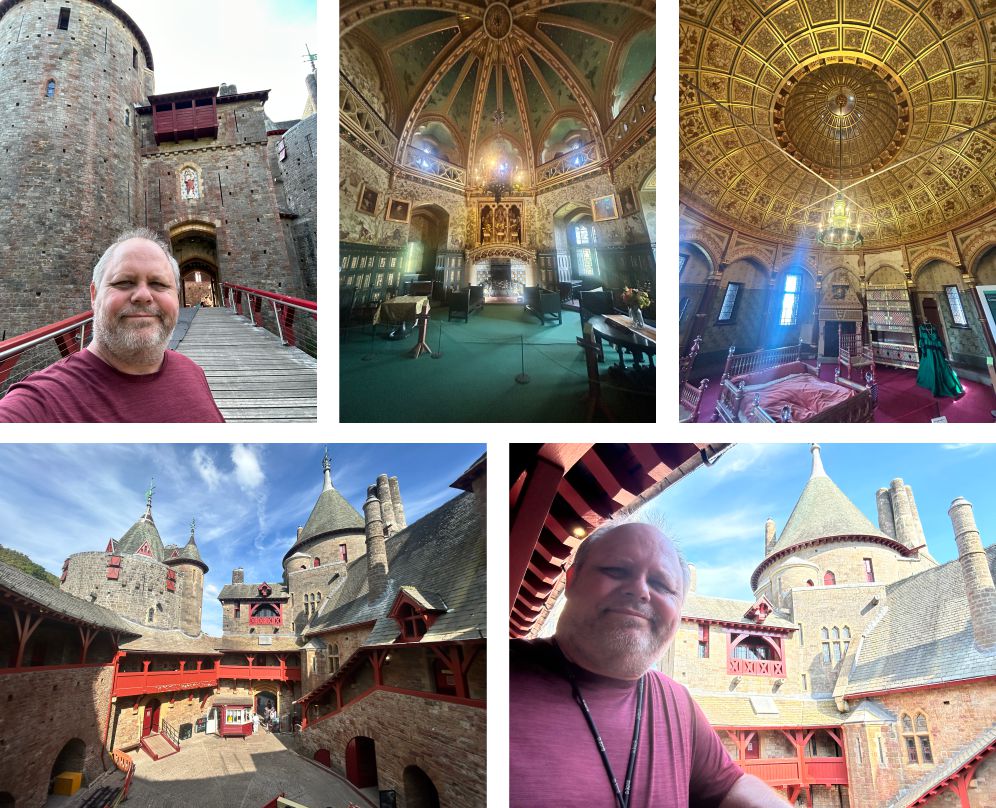
Claude did have one final recommendation for me, since I was already here anyway. A short drive outside of Cardiff sits Castell Coch. It’s a relatively young castle, as British castles go. It’s essentially Victorian, built between 1875 and 1891 for John Crichton-Stuart, 3rd Marquess of Bute. He was one of the richest men in the world, having made his fortune from the Cardiff coal industry. However, the castle stands on the previous site of a stone castle built in the 1270s, so it has a decent historical heritage. I’ve now seen Victorian mock Tudor in Shrewsbury, a 1929 mock-medieval datestone in Brecon, and now a mock Victorian castle in Cardiff. The people of history around these parts loved to emulate their own history. I’m perhaps being a little unfair to Castell Coch. Heritage or no, it’s still an impressive sight perched on a steep hillside with its three towers. Despite the climb up from the car park, the entrance ticket booth staff did let me in for free once they saw I was a sad, old, depressed, incompetent, lame, basket case who could barely breathe, much less confirm in words whether I had a blue disabled parking badge or not. That shaved £10 off my day’s expenditure, so I couldn’t complain.
With all the stairs up and down the towers, my body was increasingly giving up, so I called it a day after about 45 minutes at Castell Coch, handed back the audio guide gadget they gave me on entering, and waddled back to the car. I needed to refuel the car, so I made my way through the slowest traffic I’ve experienced since arriving in Wales to a nearby petrol station. With a couple of necessary chocolate and cola rations (shhh!—don’t tell Lisa!), that £92 purchase bought me another 750 Km of range.
Cardiff was worth the effort…just. I don’t think Lisa would have tolerated all the litter along the roadside, a clear sign it’s a city. Perhaps better worded, I don’t think John or I could have tolerated listening to Lisa complaining about all the litter. I think we would have all been miserable.
Having had a very successful road trip, the two-hour return journey was largely uneventful. I arrived to find John and Lisa playing cribbage, but I immediately tucked myself away in the crafts room so I could write up the blog while everything was fresh in my mind.
I’ve now taken in Aberystwyth, Cardigan, New Quay, the Pembrokeshire coastline, Shrewsbury, the Elan Valley dams, Brecon cathedral, the Brecon Beacons national park, Cardiff and Castell Coch. That’s collectively a decent chunk of the very best of Wales—not bad for a week. Wales still has many more gems, but I think I can be happy with my progress to date.